 Ironside Dumpster Rental
Protecting Your Driveway From a Dumpster
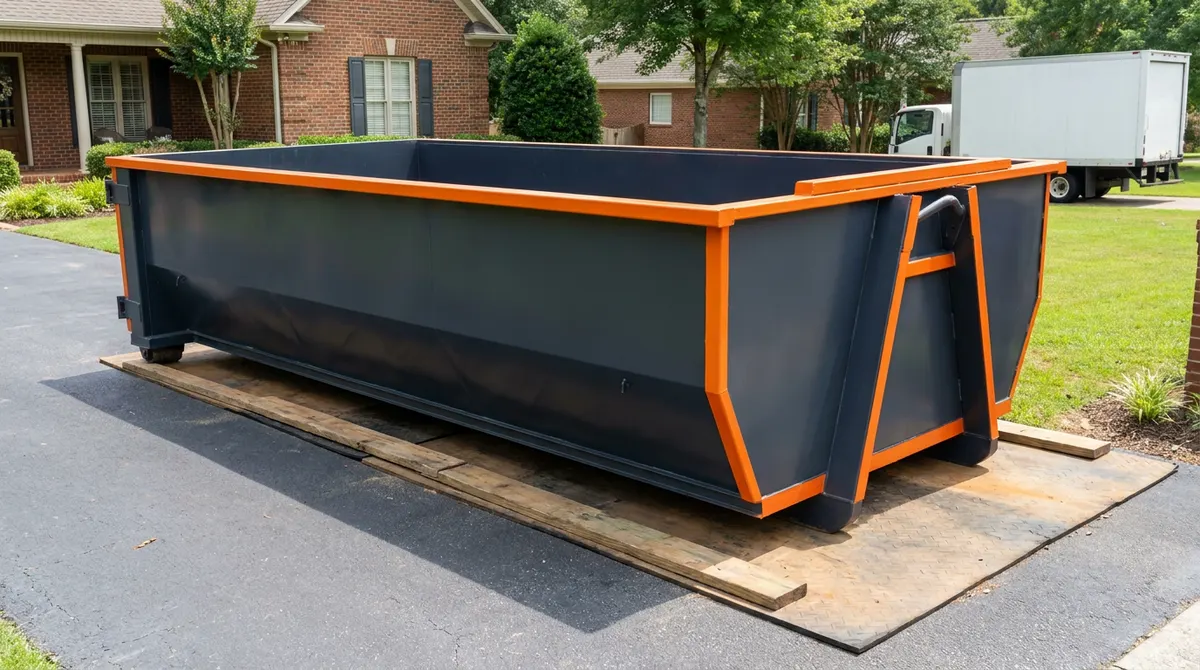
Protecting a driveway from a dumpster comes down to spreading the weight with plywood boards under the roll-off wheels and picking a placement surface that can handle 2, 6 tons of steel plus debris. I learned this the slightly embarrassing way, and the short version is: a few 2-foot squares of 3/4-inch plywood under the contact points do most of the work. Birmingham driveways run from fresh poured concrete in Forest Park to 40-year-old asphalt in East Lake, and each handles a loaded bin differently. Get the prep right and you'll hand the driveway back exactly how you found it.
Why Driveways Crack Under Heavy Dumpsters
Driveways crack under dumpsters because the entire weight of a steel roll-off body, typically 2,000 to 6,000 pounds empty, plus 2, 6 tons of debris, rides on four small steel wheels and the rear edge, which concentrates thousands of pounds onto a few square inches. That's the whole problem in one sentence. Point loads. Concrete handles broad, even weight fine, but it hates a sharp edge pressing down in one spot, especially over a hairline crack that's already there. So when a loaded 20-yard bin sits for a week, those steel feet can leave divots or start a fresh crack line. Asphalt is a different animal. It goes soft when it's hot, and Birmingham summers off Red Mountain will push driveway surface temps way up on an August afternoon. On a 95-degree day, asphalt scuffing and dent marks from roll-off wheels happen fast, the tar literally gives. The U.S. Department of Transportation's Federal Highway Administration has published plenty on how pavement behaves under concentrated loads if you want the engineering version. Older concrete in neighborhoods like Woodlawn and Norwood, where you'll find slabs poured decades ago, is more brittle and more likely to show stress. Newer pours in Crestwood or Highland Park tend to shrug it off. Point is: the surface, its age, and the summer heat all matter more than the dumpster itself.
How you protect a driveway from a dumpster
You protect a driveway from a dumpster by laying 3/4-inch plywood boards under the roll-off's wheels and rear contact points to spread the load, and by making sure the delivery driver sets it down gently rather than dragging it. Here's the simple sequence. One, clear the spot, move cars, sweep off gravel that could grind into the surface. Two, lay down two or three sheets of plywood, at least 3/4-inch thick, where the back wheels and the rear lip will land. Three, have the driver winch the bin down slow instead of letting it roll off hard. Four, when it's picked up, check underneath. That's it. The plywood does the heavy lifting here, honestly, it takes that concentrated point load and fans it out across a couple of square feet, which is exactly what weight distribution is all about. A 4x8 sheet costs around $40, $60 at a Birmingham home center, and you can reuse it. If you don't own plywood, old 2x10 boards or even thick rubber mats work in a pinch. One real caveat: don't use thin paneling or a single layer of cardboard. That's not protection, that's wishful thinking.
Plywood and Boards Do the Real Work
Plywood and boards protect a driveway by converting the dumpster's point loads into spread loads, so no single spot takes more than it can handle. Use 3/4-inch CDX plywood if you can, it's the stuff that holds up. Two sheets stacked under each rear wheel is better than one, and some folks run a continuous row of boards the full length where the bin sits. The APA, The Engineered Wood Association publishes load and span data on structural plywood if you're the type who likes to check the specs. For asphalt driveways in the summer, boards matter even more because they stop the hot wheel steel from pressing directly into soft tar. On concrete, they mostly guard against chips and divots at the contact edge. A quick tip from doing this a lot: set the plywood where the driver tells you the wheels land, not where you guess. The back of a roll-off carries most of the weight. And if your driveway has a slope, plenty of Southside and Five Points South driveways pitch toward the street, chock the boards so nothing slides. One more thing. If you're worried about staining, a layer of plywood also catches drips from whatever you're tossing, which keeps oil and paint off the slab.
Best Placement Surfaces for a Roll-Off Dumpster
The best placement surface for a roll-off dumpster is flat, solid concrete or a reinforced gravel pad, followed by sound asphalt with boards, and the street as a backup when the driveway won't work. If you've got a wide concrete driveway in good shape, think many of the newer builds around Avondale or the restored places in Forest Park, that's the ideal spot. Level, strong, and easy to clean. Gravel or a packed dirt pad is also fine and forgiving, since there's nothing to crack. Asphalt works too, just always on boards. If none of those fit, the street is an option, but Birmingham often requires a right-of-way permit for a dumpster in the public road, and parking rules vary by neighborhood, you'll want to confirm with the City of Birmingham before placing one curbside. The U.S. EPA also has guidance on keeping construction debris and runoff out of storm drains, which matters if the bin sits near the curb. Decision-wise: if your driveway is solid concrete, place it there on plywood and skip the permit hassle. If your driveway is cracked, steep, or too narrow for the truck to back in, the street with a permit is the smarter call. Avoid parking a loaded bin over a septic lid, a buried utility line, or a drainage grate, that's an edge case that bites people. When in doubt, call 811 before anyone digs or sets heavy loads, per Common Ground Alliance.
What Ironside Does to Prevent Driveway Damage
Ironside protects Birmingham driveways by placing plywood boards under the contact points on request and training drivers to set and retrieve roll-offs gently rather than dropping or dragging them. When you book, just tell us the surface, concrete, asphalt, gravel, or street, and whether it's older or sloped, and the driver plans the drop around it. On hot days, boards go under the wheels on asphalt as standard practice to prevent scuffing. The bin gets winched down slow so the rear lip doesn't gouge, and on pickup the driver pulls forward smooth so nothing scrapes. Sizes range from a 10-yard (roughly 4 pickup loads, good for a bathroom remodel in Crestwood) up to a 30-yard (a full roof tear-off in Roebuck), and the smaller bins obviously carry less concentrated weight, a 10-yard loaded is far easier on a slab than a maxed-out 30-yard. Pricing starts at a $595 minimum, and that flat number is confirmed up front, not after. If you've got a driveway you're nervous about, text a photo and we'll tell you honestly whether it should go on the slab, on boards, or in the street. You can see sizes and transparent pricing on our Birmingham dumpster rental page. The whole idea is you get the bin dropped, fill it, and hand the driveway back without a single new crack.
Quick questions
Will a dumpster crack my concrete driveway?
A dumpster can crack concrete if it's old, already hairline-cracked, or if the steel wheels sit on one spot for days, but sound concrete with 3/4-inch plywood under the contact points almost never has a problem. The plywood spreads the 2, 6 ton load so no single spot takes a sharp point load.
What goes under a dumpster to protect the driveway?
Two or three sheets of 3/4-inch plywood placed under the rear roll-off wheels and lip is the standard protection. Thick 2x10 boards or heavy rubber mats also work. Avoid thin paneling or cardboard, those won't spread the weight.
Can I put a dumpster on asphalt in the summer?
Yes, but always on plywood boards, because Birmingham summer heat softens asphalt and the steel wheels can press dents or scuff marks into it. The boards keep the hot steel off the soft surface.
Do I need a permit to put a dumpster in the street in Birmingham?
Often yes, placing a dumpster in the public right-of-way usually requires a City of Birmingham permit, and rules vary by neighborhood. A dumpster on your own driveway typically needs no permit. Confirm street placement with the city before the drop.
How much does a dumpster rental cost in Birmingham?
Pricing starts at a $595 minimum, confirmed as a flat number up front before delivery. The exact total depends on size (10 to 30 yard) and the debris type. Ballpark figures are easy to give over the phone at (205) 551-5369.
Need it handled now? See Dumpster Rental in Birmingham.